
5 Easy CVC Rhyming Activities for Kindergarten

Introduction
Rhyming is an important early literacy skill that helps young children listen carefully to words, recognize sound patterns, and prepare for successful reading and spelling.
Although rhyming may seem simple, some kindergarten students need repeated modeling, picture support, movement, and hands-on practice before they can confidently identify and produce rhyming words.
The good news is that rhyming practice does not have to feel difficult or repetitive. Short, engaging activities can help children strengthen phonological awareness while keeping learning playful and meaningful.
In this post, you will discover five easy CVC rhyming activities that can be used during whole-group lessons, small-group instruction, literacy centers, intervention, or at-home practice.
What Are CVC Words?
CVC words follow a consonant-vowel-consonant pattern.
Examples include:
Cat
pig
sun
bed
hop
CVC words are helpful for beginning readers because they usually contain short, predictable sound patterns.
When students work with rhyming CVC words, they begin to notice that words can share the same middle and ending sounds.
Examples include:
cat, hat, mat
pig, wig, dig
sun, run, fun
bed, red, fed
hop, mop, top
This understanding supports phonological awareness, decoding, word-family recognition, spelling, and early reading fluency.
1. Rhyming Picture Match
Picture matching is an excellent starting activity for students who are still developing vocabulary or learning to hear rhyming sounds.
Show students two or more picture cards and say each word aloud.
For example, display pictures for:
cat
hat
dog
Ask:
“Which word rhymes with cat?”
Students can point to, hold up, or place the matching picture beside the target word.
Teacher Tip
Say each word clearly and emphasize the ending sounds.
For example:
“C-at, h-at. Cat and hat rhyme because they both end with /at/.”
Picture support allows children to focus on the sounds without needing to read every word independently.

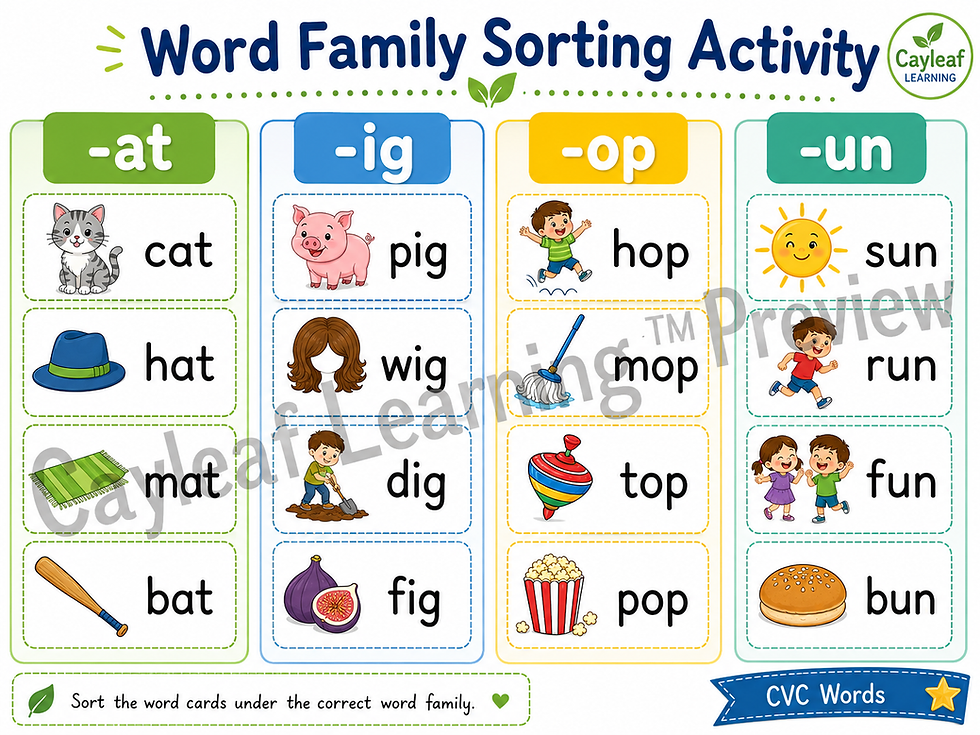
2. Rhyming Word-Family Sort
Word-family sorting helps students recognize groups of words that share the same ending pattern.
Create word-family headings such as:
-at
-ig
-op
-un
Provide students with word cards or picture cards to sort under the correct heading.
-at Family
cat
hat
mat
bat
-ig Family
pig
wig
dig
fig
-op Family
hop
mop
top
pop
-un Family
sun
run
fun
bun
Students can complete the activity on the floor, in a pocket chart, on a magnetic board, or at a literacy center.
Differentiation Idea
For students who need additional support, begin with only two word families.
For students who are ready for a challenge, mix three or four word families together and ask them to explain how they made each match.
3. Find the Rhyming Pair
Place several picture or word cards face down.
Students take turns selecting two cards.
If the words rhyme, the student keeps the pair. If the words do not rhyme, the cards are returned to the same location.
Possible rhyming pairs include:
cat and hat
pig and wig
log and dog
sun and run
bed and red
This activity works well in a small group or partner literacy center.
It also helps students practice memory, turn-taking, oral language, and careful listening.
Teacher Prompt
Ask students to say both words aloud before deciding.
For example:
“Cat, hat. Do these words sound the same at the end?”
Encourage students to explain their thinking instead of answering only yes or no.
4. Rhyming Movement Game
Young children often benefit from movement during phonological-awareness practice.
Tell students that they will perform a movement when they hear two rhyming words.
For example:
Clap if the words rhyme.
Stomp if the words do not rhyme.
Jump when you hear a rhyming pair.
Touch your head when the words have the same ending sound.
Say word pairs such as:
cat, hat
pig, sun
log, frog
bed, red
top, fish
This activity can be used as a warm-up, brain break, transition, or quick review.
Classroom Management Tip
Model the movements before beginning.
Remind students to wait until both words have been spoken before responding. This helps them listen carefully instead of guessing.
5. Finish the Rhyme
Finish-the-rhyme activities encourage students to produce rhyming words instead of only recognizing them.
Say a sentence and ask students to complete it with a word that rhymes.
Examples:
“The cat sat on the _____.”
Possible answer: mat
“I see a pig wearing a _____.”
Possible answer: wig
“The fox jumped on the _____.”
Possible answer: box
“The hen slept in the _____.”
Possible answer: pen
Producing a rhyme is often more difficult than identifying one, so some students may need picture choices or verbal support.
Support Strategy
Offer two choices when needed.
For example:
“Did the cat sit on the mat or the sun?”
This reduces frustration while still helping students hear and select the correct rhyme.
Questions to Ask During Rhyming Practice
Use thoughtful questions to help students explain what they hear.
Try asking:
What sound do these words share?
How do you know these words rhyme?
Can you think of another word that rhymes?
Which word does not belong?
What word-family pattern do you notice?
Do these words sound the same at the beginning or the end?
These questions help students think more deeply about spoken and printed word patterns.
How to Support Students Who Struggle With Rhyming
Some kindergarten students may not hear rhymes immediately. This does not mean they cannot learn the skill.
Students may need:
repeated oral modeling
fewer answer choices
familiar picture vocabulary
exaggerated ending sounds
hand motions or movement
practice with one word family at a time
small-group instruction
daily review
Begin with familiar words such as cat, hat, sun, run, pig, and wig.
Avoid beginning with pictures or vocabulary that students may not recognize.
Keep practice short, positive, and consistent. Five minutes of focused rhyming practice each day can be more effective than one long lesson.
Using Rhyming Activities in Literacy Centers
Rhyming activities can be included in several classroom centers.
Teacher-Led Center
Practice identifying and producing rhymes using picture cards, word cards, oral modeling, and immediate corrective feedback.
Independent Center
Students match, sort, circle, color, or connect rhyming pairs.
Partner Center
Students play a rhyming memory game or take turns naming words that rhyme.
Writing Center
Students draw two rhyming pictures and attempt to label each picture.
Technology Center
Students listen to words and select the matching rhyming picture.
Center activities should include clear visual directions so students can work with increasing independence.

Informal Rhyming Assessment
Teachers can quickly assess rhyming skills without giving students a lengthy test.
Ask each student to complete the following tasks:
Identify which two words rhyme.
Match two rhyming pictures.
Identify the word that does not rhyme.
Produce a word that rhymes with a given word.
Record whether the student completes each skill:
independently
with support
not yet
This information can help teachers form small groups and determine which students need additional practice.
Make Rhyming Practice Easier
Preparing picture cards, word-family sorts, reference charts, and student activities can take valuable planning time.
The Cayleaf Learning CVC Rhyming Word Families resource was created to help kindergarten and first-grade students practice rhyming through clear, age-appropriate activities.
The resource can be used for:
phonics centers
small groups
morning work
intervention
early finishers
homework
review
substitute plans

Final Thoughts
Rhyming instruction is most effective when students can hear, say, see, sort, and play with words.
By combining oral practice, pictures, movement, and word-family activities, teachers can make. rhyming instruction accessible to a wide range of learners.
Start with one simple activity, repeat it throughout the week, and gradually increase the level of difficulty as students become more confident.
For more kindergarten phonics activities, literacy-center ideas, and classroom-ready resources, visit Cayleaf Learning on Teachers Pay Teachers.https://www.teacherspayteachers.com/store/cayleaf-learning.


Comments